The Weight of the Thing
The boutique was so small I almost walked past it. Something
caught — a window full of wrong combinations that were
somehow right, enamel, gold and stones arranged with the
confidence of people who had stopped asking for permission.
I went in.
Maya, Meena, and Zeenat Mukhi were all three inside, which
felt improbable for a space that size. They recognised me before
I said anything. Not from anything I had done. From a winter
Chanel jacket I had worn in the middle of a Beirut summer, in a
television interview, over a white T-shirt and jeans. I was obese
at the time, and it was the only good thing that fit me, so I wore
it. This, apparently, had entered the Mukhi family record. Their
mother, Effat, had watched the interview and dressed down the
girls afterwards for not raiding her own archive of vintage
labels and dressing accordingly. I had inadvertently provoked a
fashion argument in a household I had never entered. We were
friends by the time I understood this.
The Mukhis have been in the jewellery business since before
Beirut was the city it became, and after that, it was no longer that city
either. Their grandfather, Pessumal, came from India in the
1950s and opened stores across the Levant — fine jewellery
alongside textiles, crystal, imported goods from the Far East —
the kind of merchant premises that sold beautiful things before
Beautiful things had their own category. His son Chander stayed
In Beirut during the war, he married a Lebanese woman
named Effat Kreidieh, who then opened her own jewellery label in 1982, with the quiet determination of someone who did not
require an occasion. Between them, they raised three daughters
in a household that celebrated Diwali and Ramadan and
Christmas, attended private trade shows as a family activity,
and discussed the science of gemstones at the dinner table as other families discuss football.
I had known of Shandu Mukhi and Effat since I was a child. In
the Lebanon I grew up in, certain names were present in
the texture of things — the stores you were taken to, the pieces
your aunties pointed at, the language of elegance that was
transmitted not by instruction but by proximity. Jewellery in
this world was never decorative in the light sense. It was the
thing you kept when everything else was lost. It was the
argument you wore on your hand.
What the sisters built in 2009, in a boutique in Downtown
Beirut, was their own translation of all of this — Indian
mythology in the stone choices, Lebanese colour in the enamel
palette, and a persistent refusal to produce anything twice in
large numbers. They named the brand after the sisterhood rather
than the family, which was a statement dressed as a naming
convention. In Lebanon, businesses are passed down to sons and brothers.
The Mukhis named theirs after sisters, because their mother had
shown them that a woman could decide to make
something and then make it.
Learning to stack jewellery with them was an education in
restraint and excess simultaneously. The instinct, confronted
with so many right pieces, is to wear everything. They corrected
this tendency with the patience of people who had been
correcting it in clients for years. You wear three or thirteen,
they would say "follow what you feel like". And if you walk
out like a Christmas tree and you love it, so be it. This was a
philosophy I found considerably easier to adopt than most.
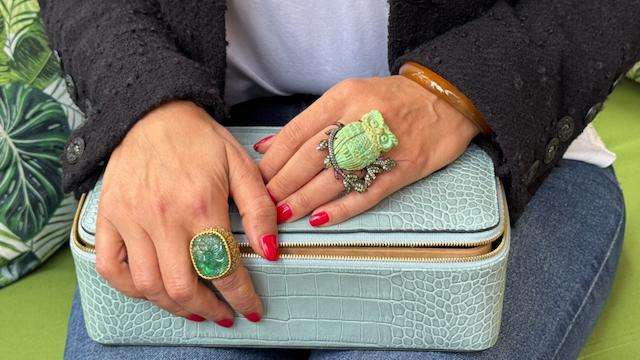
There was a ring in Effat's boutique. An emerald cocktail ring
—green, the particular green that emeralds achieve when they
have nothing to prove, set in gold, not small. I saw it in 2014, tried it on the
first time and put it back. I came back and tried it on
again. This happened across 10 years and multiple visits, a
ritual so consistent it had become something close to a
relationship. I would say, one day, meaning: one day I will be
the person this ring is for. The ring, for its part, waited.
When I finally bought it, I did not feel the triumph I had
imagined. I felt something quieter and more accurate — the
particular satisfaction of arriving somewhere you had been
walking toward for a long time without admitting it. The ring
was not the reward. The ten years were.
Some objects have the patience to wait until you become ready
to carry them.