She Does Not Run
Across six television productions on three continents, the same narrative structure recurs: a woman is handed a verdict. She declines it. What follows is construction.
She does not run. That is the first thing to notice. Moon Dong-eun — twenty-eight years old, working the counter of a convenience store, saving money with the patience of someone who has already decided how this ends — does not flee the city where her tormentors live, does not pursue therapy, does not report anything to anyone. Instead she enrols in a teaching qualification programme, waits for the woman who burned her with a curling iron to have a child, and then engineers her appointment as that child's homeroom teacher. The Glory opens not with violence but with the completion of an eighteen-year administrative project. The revenge begins, formally, with a seating chart.
This is the grammar the piece is about.
Across six television productions made on three continents over sixteen years — Straight to Hell (Japan, 2026), Ashes to Crown (China, 2026), The Glory (South Korea, 2022–23), The Law According to Lidia Poët (Italy, 2023–ongoing), Self Made: Inspired by the Life of Madam C.J. Walker (United States, 2020), and La Reina del Sur (Spain/Mexico, 2011–present) — the same narrative structure recurs with a consistency too precise to be coincidental. A woman is handed a verdict. She declines it. What follows is not liberation. It is construction. The drama is never about the refusal itself. The drama is always about what she builds afterwards, and what it costs.
This is not a piece about strong female characters. That frame is inaccurate and, by now, quite boring. These productions are doing something structurally specific, and it is worth naming precisely.
One: The Verdict
In each of the six productions, the narrative opens with what might be called a societal verdict — a determination, delivered not by a single antagonist but by a system, about what the protagonist is for. The verdict arrives through different channels: postwar poverty in Japan, the logic of dynastic sacrifice in imperial China, the social impunity of Korean class wealth, the codified exclusion of the nineteenth-century Italian legal establishment, the American racial caste system that stacked race on top of shade, the narco economy of Sinaloa. What the channels share is that the verdict is structural rather than personal. No individual decided that Kazuko Hosoki would disappear. No individual decided that Lidia Poët would be struck from the bar. The decision was made by the arrangement of things — by history, by law, by the accumulated weight of what everyone agreed was simply the way it worked.
This is what makes each refusal so expensive. You cannot argue with a system the way you can argue with a person. The antagonist, in each of these productions, is never quite on screen.
The verdicts arrive in forms that would be politely unrecognisable to someone watching from a comfortable distance. Sarah Breedlove — not yet Madam C.J. Walker, still hauling other people's laundry — does not receive a letter informing her that her race and the precise shade of her skin have determined the ceiling of her ambitions. She receives the ordinary texture of her life: the jobs available, the neighbourhoods accessible, the products sold and not sold, the entrepreneurs who will speak to her and those who will not. The verdict is ambient. It requires no author because it requires no single act.
Chu Zhao's verdict is more legible. She is the daughter of a loyal general, and the Crown Prince requires a wife from a loyal general's household, and so she marries him, and so her family is massacred when his ambitions exceed his gratitude. The verdict is a marriage contract. In Ashes to Crown — adapted from a web novel by Xi Xing and currently one of the most-watched productions on Netflix's Chinese slate — the rebirth trope does not soften this. It simply allows the series to state the verdict in its starkest form by showing what happens when it is accepted: everyone dies. Including her.
Teresa Mendoza's verdict is the bluntest of the six. Her husband has stolen from the cartel. The cartel requires her death as a consequence. She is collateral. The first season of La Reina del Sur — now in its fourth season after fifteen years and an International Emmy — opens with her running from men with guns, which is as unambiguous a statement of one's assigned social position as television has produced.
Two: The Moment of Refusal
In The Glory, the moment is the seating chart. Not the decision to seek revenge — that was made in a hospital bed, aged seventeen, while looking at her own burned skin — but the specific administrative act of placing herself, as teacher, across a classroom from her tormentor's daughter. It is a bureaucratic move, quiet and clean, and it is the most frightening thing in the series because it demonstrates a mind that has been planning for nearly two decades. Moon Dong-eun does not snap. She files paperwork.
In Straight to Hell, the moment is earlier and less tidy. Kazuko Hosoki — played by Erika Toda with a quality reviewers have described as "chameleon-like" and that is better described as strategic legibility: always performing, always knowable only on her own terms — is working in a Ginza hostess club when she decides, at some point that the series deliberately refuses to stage as a single scene, that the labour she is performing for others is labour she could be collecting for herself. She opens her own club. The refusal is not dramatic. It is a business decision. Straight to Hell spans sixty years and has the wisdom to understand that the refusal of a fate is rarely a moment at all — it is a pattern of decisions, compounding, that only becomes legible as refusal in retrospect.
Self Made handles this differently. The moment for Sarah Breedlove arrives not as an internal decision but as an external insult: Addie Munroe — a wealthy, light-skinned entrepreneur who has already cornered the market in hair products for Black women and intends to keep it — turns her away. The refusal begins as a response to humiliation. What is analytically interesting is that it begins there, not with some prior vision of self-invention. Sarah Breedlove does not dream herself into entrepreneurship. She is refused entry into someone else's version of it and decides, from that exclusion, to build her own.
This is a structural difference worth noting. Dong-eun's refusal is long-planned. Hosoki's is gradual and opportunistic. Breedlove's is catalytic — ignited by precisely the kind of gatekeeping it then dismantles. In Ashes to Crown, the moment is the simplest of all: Chu Zhao opens her eyes on the morning of the wedding that killed her, and understands that she already knows how this ends. Teresa Mendoza's refusal is not planned. It is not catalytic. It is survival — which is, in its own way, a refusal: to die as instructed.
Three: The Building Project
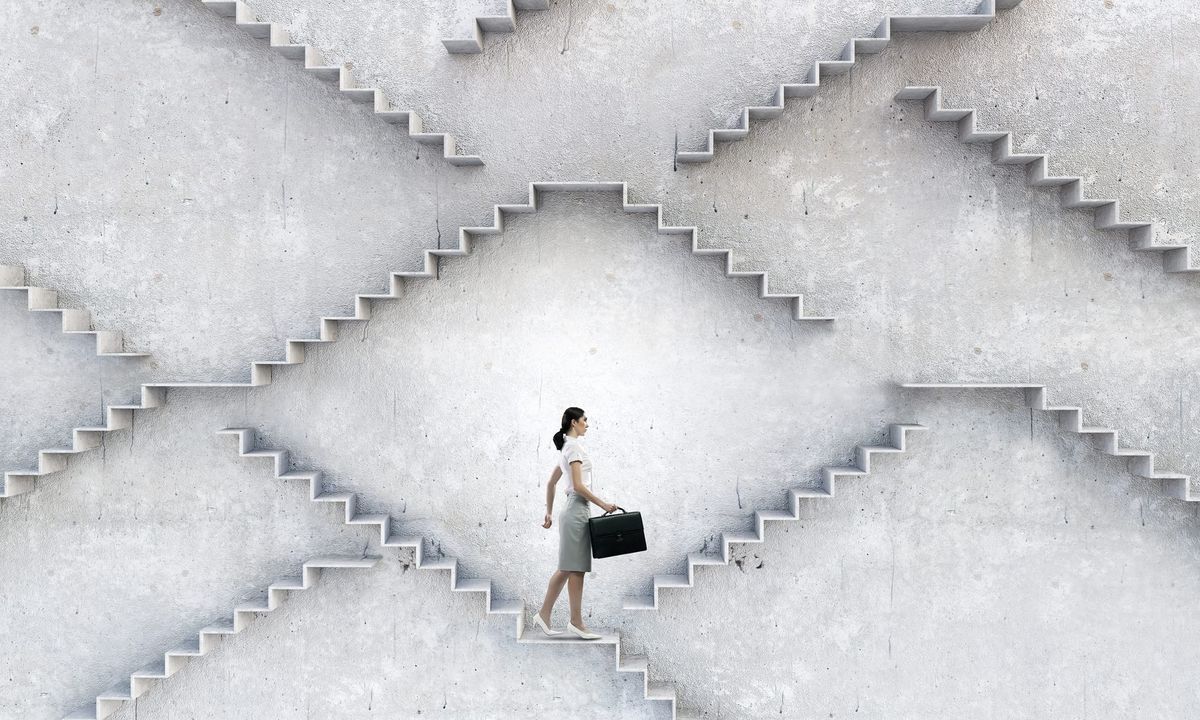
What none of these women do, after refusing their verdict, is escape it. It is where most of the drama lives.
Moon Dong-eun does not leave. She returns, and she builds. The metaphor is not incidental — she was meant to be an architect, and was denied it, and the series is structured as an architectural project: the careful surveying of a site, the laying of foundations, the patient construction of something designed to stand. The Korean board game Go functions as the series' explicit analogy: unlike chess, which is won by direct capture, Go is won by encirclement — surrounding your opponent, gradually, without their noticing, until their position has been made untenable by the accumulation of your own. It is a game of patience and position, not attack. Dong-eun does not punch her way through anything. She positions.
Kazuko Hosoki builds something more peculiar: a persona so complete it becomes indistinguishable from a person. Fortune-telling, in postwar and then bubble-era Japan, occupied a cultural position that is difficult to translate — it was mainstream and stigmatised simultaneously, a form of entertainment that carried genuine cultural authority while being structurally excluded from the economy's respectable sectors. Hosoki understood this and worked it. Her television persona — blunt, costumed, oracular, offering her catchphrase "you're going to hell!" to studio audiences who found it thrilling — was a construction as deliberate as any architectural drawing, built from the materials available to a woman in the mizu shōbai, the "water trade" of Japan's nightlife economy, who had decided that visibility was the only form of capital she could accumulate without permission. Even within the mizu shōbai, rank was carefully maintained: to work in Ginza, rather than in the rougher districts further from the centre, was itself a social distinction — a status within a stigmatised trade, which is to say a hierarchy within an exclusion. Hosoki began there and then rendered the entire structure irrelevant. Straight to Hell is the most formally interesting of the six productions in this respect: it frames Hosoki's life through a novelist commissioned to ghostwrite her autobiography, which is to say it is, at its structural core, a series about the gap between the story a woman constructs for public consumption and whatever truth, if any, underlies it. The series does not resolve this. Nor should it.
Sarah Breedlove builds what the series calls an empire and what is, with more precision, a new market. The history here matters: Walker's hair-care products and her army of door-to-door saleswomen — she had trained nearly twenty thousand agents by 1917, two years before her death — were not simply a business. They were an economic infrastructure built specifically for Black women, by a Black woman, within a segregated America that provided no other access to either the products or the employment. The building project was also, in this case, a social project. Walker's philanthropy — funding anti-lynching campaigns, supporting the NAACP, contributing to homes for the elderly and the arts — was continuous with the business, not ancillary to it. Self Made fictionalises and compresses this into a cleaner arc than the historical record quite supports, which is worth noting: the gap between the documented Walker and the series' version is itself a small argument about what contemporary audiences require from a "building" story. We appear to require it neater than it was.
Teresa Mendoza does not build clean things, and what she builds is not a market or an infrastructure — it is a network of loyalty, of logistics, of the kind of trust that exists between people who cannot call the police — and she builds it in the grey economy that exists beneath and alongside Europe's legitimate one. The Costa del Sol locations of the first season, and the South American landscapes of the third — salt flats, glaciers, Machu Picchu — function less as backdrops than as evidence: here is the territory of her kingdom, here is how much she controls. The building project in La Reina del Sur is always also a sovereignty project. Teresa does not want to be admitted to an existing structure. She wants her own.
Lidia Poët also wants to be admitted to an existing structure, and the distinction is the most analytically productive tension across the six productions. She wants the law. Not a parallel version of it, not an informal practice that sidesteps it, but the law itself — the right to be listed on the register of advocates in Turin, to argue before a court, to be recognised as what she demonstrably is. Her building project is the construction of the legal argument for her own professional existence, which she assembles, over the course of the series, through the cases she works — unofficially, through her brother's practice — and the precedents she accumulates. Every case she solves is, in structural terms, evidence submitted in the case of Poët versus the State of Italy.
The Law According to Lidia Poët concluded its run in April 2026, and the choice of final season is worth noting. The central case of its third and last season involves a woman who killed her husband and is arguing self-defence before an all-male jury. Lidia is arguing the case — informally, as she must — at the same moment the series is making its own concluding argument about whether the law, given enough time and enough Lidias, actually changes. The series ended while this article was being written. The timing is either a coincidence or it is, itself, a small piece of the grammar: the building project continues until it runs out of episodes, or until — as the historical record shows — the woman building it is sixty-five years old and the institution she was arguing with finally, with minimal fanfare, adds her name back to the register.
Coda
What the grammar describes, in the end, is not heroism. It is something more ordinary and more structurally precise: the particular form of labour required of a person who has been handed a verdict by a system and has decided not to accept it.
The six productions span sixteen years, three continents, four languages, and genres that share almost nothing except this. They were made independently, by different writers and directors and production companies, for different cultural audiences. They are not a movement. They are a pattern — and the pattern's consistency is more interesting than any individual entry in it, because a pattern this persistent is usually pointing at something real.
The question the pattern raises is not about these six women, and not about television. It is about what a person is required to construct — from nothing, incrementally, over years or decades — when the world has decided, through its accumulated arrangements, what she is for. The answer, across all six productions, is the same: everything. She is required to construct everything.
The building project is never finished. That is also part of the grammar.
All six series streaming on Netflix globally as of June 2026. The Law According to Lidia Poët Season 3 — the series' final season — premiered Netflix globally April 2026.