THE IMPERFECT SURFACE
On what handmade objects carry that mass-produced ones cannot — and what we owe them in return.
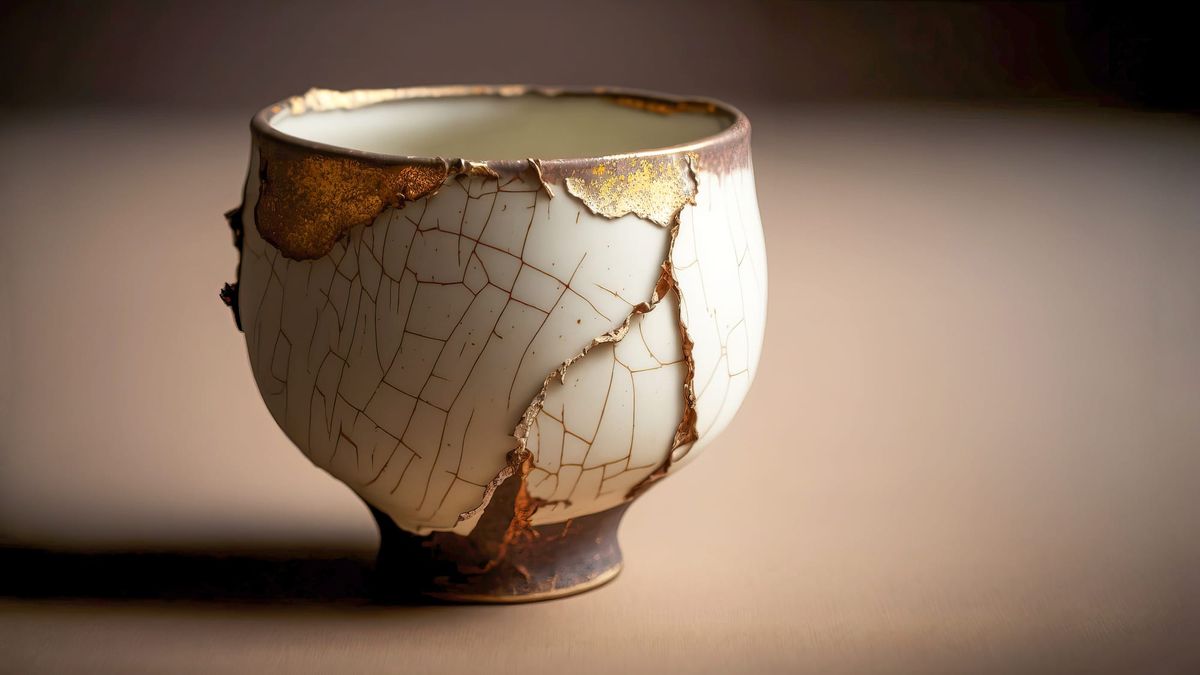
The bowl has a dent in its rim. Not a crack, not a chip — a dent, the kind made when something wet and slightly uncentred meets the edge of a kiln shelf and the potter decides, or perhaps simply accepts, that this is what the bowl is now. It holds soup. It holds its shape. It holds, in that small compression of clay, the exact moment someone was paying attention to something else.
This is what we mean when we say handmade, though we rarely say what we mean.
The word has become a marketing category — shorthand for premium, for slow, for the vaguely ethical. It appears on candles, on cutting boards, on gin. What it originally described was simpler and less comfortable: the evidence of a human body working, with its particular set of limitations, on a material that does not forgive. Every handmade object is, at its core, a record of someone's physical encounter with matter. The surface is not decoration. It is documentation.
Industrial production eliminated this not because it was ugly but because it was inconsistent. The machine's great achievement — its actual genius, if you want to be generous about it — is the identical object. The second mug and the thousandth mug are the same mug. This is what efficiency looks like when it reaches completion, and for a long time it looked like progress.
What we are noticing now, with some embarrassment, is that we cannot tell them apart.
The handmade object carries information the machine-made one cannot. Run your thumb across the inside of a thrown ceramic bowl and you feel the ridge where the potter's finger moved faster than the wheel; feel the slight asymmetry where the wall thickened at the base because that is where clay tends to go when it is not being watched. None of this was intended. All of it is accurate. The object is a transcript of a series of decisions made in real time under conditions that included gravity, fatigue, and the particular properties of this batch of clay on this morning. You are holding an event.
The question this raises — the one we avoid asking because the answer is demanding — is what we owe such an object. Not reverence. Reverence is just guilt in a clean coat. What an object that carries this kind of information requires is attention: the willingness to actually look at what you are holding before you put it down.
We have become very good at owning things. We have become considerably worse at noticing them.
There is a cast iron pan in my kitchen that belonged to someone's grandmother before it belonged to the person who sold it to me at a market in Liège on a wet Saturday, and before that it belonged to a foundry in Wallonia that closed in 1987, and before that it belonged to the foundry worker who poured it and whose hands, in some utterly unscientific but not entirely untrue sense, are still somewhere in its surface. The seasoning it carries is forty years of use — lard and butter and heat and time, polymerised into something that no product, however expensive, has managed to replicate. It cooks differently from a new pan. It tastes of something that did not come from a factory.
I am aware that this is the kind of sentence that appears in catalogues for artisanal goods and then in the receipt for one hundred and eighty euros. But the catalogue is not wrong. It is just commercialising a fact that was true before anyone thought to charge for it.
The imperfect surface is not an aesthetic preference. It is not the design equivalent of liking vinyl for the warmth. It is a claim about what we think objects are for — whether they exist to be consistent or to be specific, whether we want them to reflect a process or erase it. And it is, finally, a claim about time: whether we want to own something that exists entirely in the present, or something that arrived from somewhere and will outlast us.
The bowl with the dent in its rim will be here after I am not. The dent will still be there. So will the decision — or the acceptance — that made it.
That is what it means for an object to be made by hand. Not that it is more beautiful. That it remembers.