The Woman Who Drew the Map
A review of Janet Wallach's Desert Queen — the biography of Gertrude Bell, the woman who helped draw the borders of modern Iraq and was ignored for understanding them too well.
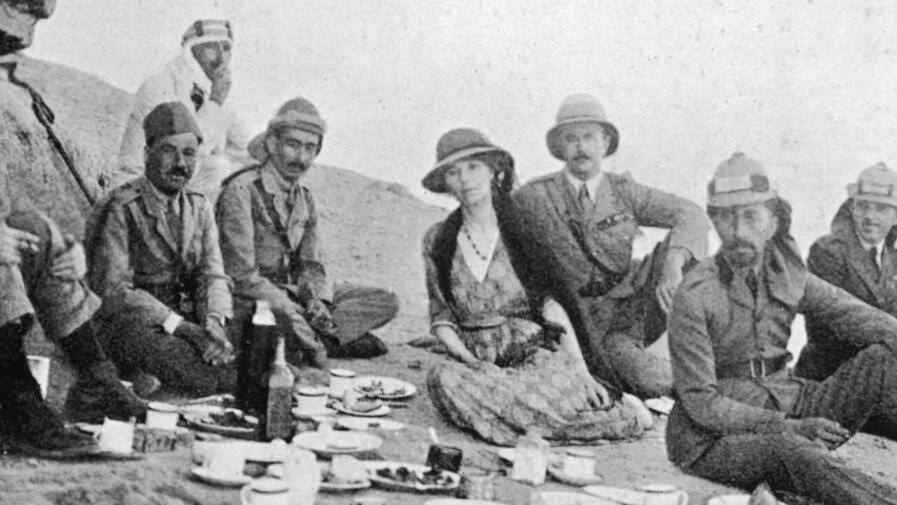
The photograph from the Cairo Conference of 1921 is worth studying. Forty men — Churchill, Lawrence, Faisal's representatives, colonial administrators in their best suits — and one woman. She is half-smiling. She is not looking at the camera. She is looking ahead, at something outside the frame.
That image does not appear in Janet Wallach's biography, but it might as well open it. Desert Queen is the story of a woman who spent her life seeing what the men around her refused to see — and who deployed that clarity in service of the empire that employed her. The contradiction never resolves. Wallach, to her credit, does not try to resolve it.
Gertrude Bell arrived in the Middle East by refusing to stay in England. Born in 1868 to a wealthy Yorkshire family, she collected an Oxford first in history, learned Farsi, then Arabic, and began writing about the region with the authority of someone who had walked it, slept in Bedouin tents, and been simultaneously arrested and feted by tribal warlords. By the time the Ottoman Empire collapsed, she was the British government's most reliable intelligence on the region. She helped draw the borders of modern Iraq with the certainty of someone who had actually met the people those borders would contain.
Wallach traces this arc with care. The early chapters — Bell navigating the social humiliations of being too intelligent for the rooms she was placed in — establish the psychological pattern of her life: perpetually more competent than the institutions she served, perpetually denied the recognition that would have been automatic for any man doing the same work. She was the de facto political officer in Baghdad during the Mandate. She had no official title.
The tragedy Wallach documents with most empathy is the personal one — the impossible love affair with a married man killed at Gallipoli, the aging into irrelevance as the men she had advised began to sideline her. That tragedy is readable. Biographies know how to tell it. The structural one is harder. Bell was fluent in Arabic, understood tribal politics, and grasped the difference between Sunni and Shia governance with a sophistication almost no Western official possessed then or possesses now. She used that knowledge to crown Faisal and argued, correctly, that Iraq was three distinct societies forced inside one artificial state. She did this in service of an empire that had already decided the outcome and needed her expertise to manage the friction.
The borders she helped negotiate are the borders that still define the region's instability. She knew they were imperfect. She argued for alternatives and was overruled. What she built lasted long enough to collapse into the specific shapes of the disasters that followed.
Desert Queen is not a flawless biography — Wallach occasionally lets the adventure crowd out the analysis, and the prose wanders where it should press. But it is a necessary one. Bell is too often reduced to a curiosity: the woman at the Lawrence of Arabia table. The more important question is what it means that the person with the most accurate understanding of the region had the least formal power to act on it.
She drew the lines. She saw what they would produce. She was ignored.